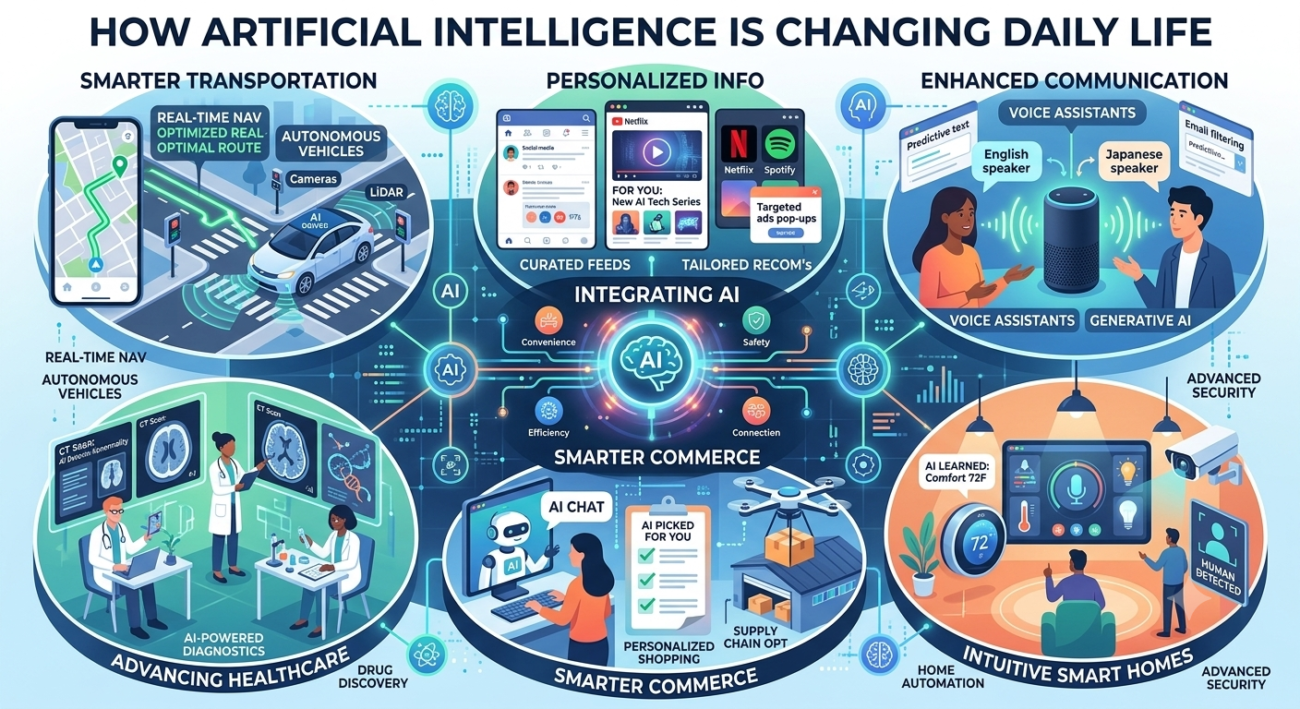
Artificial intelligence, often called AI, has become part of everyday life. Many people use it without even realizing it. From getting directions on a map to receiving movie recommendations, AI quietly helps with many daily tasks.
As technology continues to improve, AI is becoming more useful at home, at work, in healthcare, education, and entertainment.
This guide explains how artificial intelligence is changing daily life, the benefits it offers, and the challenges people should keep in mind.
What Is Artificial Intelligence?
Artificial intelligence is technology that allows computers and software to perform tasks that normally require human intelligence.
These tasks include:
- Understanding language
- Recognizing images
- Learning from data
- Solving problems
- Making recommendations
- Answering questions
AI doesn’t think like a person. Instead, it uses data and patterns to help complete specific tasks more efficiently.
Why AI Matters in Everyday Life
AI is designed to make many daily activities easier.
It can help people:
- Save time
- Improve productivity
- Find information quickly
- Automate repetitive tasks
- Personalize digital experiences
- Make better decisions with data
As AI tools become more common, they’re changing how people work, learn, shop, and communicate.
1. AI Helps People Work More Efficiently
Many workplaces now use AI to handle routine tasks.
Examples include:
- Organizing emails
- Scheduling meetings
- Creating summaries
- Managing customer support
- Analyzing business data
This allows employees to spend more time on creative thinking and problem-solving.
2. AI Supports Learning
Students and professionals use AI to:
- Explain difficult topics
- Summarize long documents
- Practice writing
- Generate study questions
- Learn new languages
AI doesn’t replace teachers, but it can be a useful learning tool when used responsibly.
3. AI Improves Online Shopping
Shopping websites often use AI to recommend products based on browsing history and previous purchases.
AI can also help by:
- Suggesting similar items
- Comparing prices
- Predicting delivery times
- Improving search results
These features make online shopping faster and more convenient.
4. AI Makes Navigation Easier
Navigation apps use AI to analyze traffic conditions and suggest faster routes.
They can:
- Avoid traffic jams
- Estimate arrival times
- Recommend alternate roads
- Update directions in real time
This helps people save both time and fuel.
5. AI Changes How We Communicate
Many messaging apps and email services use AI features such as:
- Smart replies
- Grammar suggestions
- Translation
- Spam filtering
- Voice typing
These tools make communication quicker and more accurate.
6. AI Helps Create Content
Writers, designers, marketers, and creators increasingly use AI to assist with their work.
AI can help generate:
- Article ideas
- Images
- Video captions
- Presentation outlines
- Social media posts
- Basic code
People still review and improve the final result, but AI often speeds up the creative process.
7. AI Supports Healthcare
Healthcare professionals use AI to assist with certain tasks.
Examples include:
- Analyzing medical images
- Supporting diagnosis
- Organizing patient records
- Monitoring health data
- Assisting research
Doctors continue to make important medical decisions, while AI serves as a helpful support tool.
8. AI Improves Customer Service
Many companies use AI-powered chatbots to answer common customer questions.
They can help with:
- Order tracking
- Account information
- Frequently asked questions
- Appointment scheduling
For more complex issues, customers are usually connected with a human representative.
9. AI Personalizes Entertainment
Streaming platforms use AI to recommend:
- Movies
- TV shows
- Music
- Podcasts
Recommendations are based on your viewing or listening habits, making it easier to discover content you may enjoy.
10. AI Helps Manage Smart Homes
Many smart home devices use AI to improve convenience.
Examples include:
- Voice assistants
- Smart lighting
- Smart thermostats
- Security cameras
- Robot vacuum cleaners
These systems can automate everyday tasks and improve energy efficiency.
11. AI Assists with Financial Management
Banks and financial apps use AI for tasks such as:
- Fraud detection
- Spending analysis
- Budget recommendations
- Investment insights
- Transaction monitoring
These tools help improve security and provide useful financial information.
12. AI Supports Everyday Productivity
Many people now use AI to organize daily life.
It can help with:
- Creating to-do lists
- Planning schedules
- Summarizing meetings
- Brainstorming ideas
- Managing projects
These tools save time and help people stay organized.
Benefits of Artificial Intelligence
AI offers many practical advantages.
Some of the biggest benefits include:
- Faster access to information
- Better productivity
- Time savings
- Improved accuracy for repetitive tasks
- Personalized recommendations
- Increased convenience
When used wisely, AI can simplify many parts of daily life.
Challenges of AI
AI also comes with important challenges.
These include:
- Privacy concerns
- Incorrect information
- Bias in AI systems
- Job changes in some industries
- Overdependence on technology
Using AI responsibly means checking important information and protecting personal data.
Everyday Uses of AI
| Area | How AI Helps |
|---|---|
| Work | Automates routine tasks |
| Education | Supports learning and research |
| Shopping | Recommends products |
| Navigation | Finds efficient routes |
| Communication | Improves writing and translation |
| Healthcare | Assists medical professionals |
| Banking | Detects fraud and analyzes spending |
| Entertainment | Suggests content |
| Smart homes | Automates household tasks |
| Productivity | Organizes schedules and projects |
Tips for Using AI Responsibly
AI works best when combined with human judgment.
Keep these tips in mind:
- Verify important information.
- Protect your personal data.
- Don’t rely on AI for every decision.
- Use AI to assist your work, not replace critical thinking.
- Stay informed about new AI tools and updates.
Responsible use helps you get the most value from AI.
Frequently Asked Questions
What is artificial intelligence?
Artificial intelligence is technology that enables computers and software to perform tasks such as learning from data, recognizing patterns, understanding language, and solving specific problems.
How does AI help in everyday life?
AI supports many daily activities, including navigation, online shopping, communication, education, healthcare, entertainment, and workplace productivity.
Is AI replacing human jobs?
AI is changing some types of work by automating repetitive tasks. At the same time, it is creating new opportunities and changing the skills many jobs require.
Is artificial intelligence safe to use?
AI can be useful when used responsibly. It’s important to verify important information, protect your personal data, and understand that AI can sometimes make mistakes.
Will AI become more common in the future?
Yes. AI is expected to become more integrated into daily life as technology continues to improve, offering new tools and services across many industries.
Final Thoughts
Artificial intelligence is already part of everyday life, even if we don’t always notice it. From helping us find the fastest route home to making work more efficient, AI continues to change how we live, learn, and communicate. While AI offers many benefits, it’s important to use it thoughtfully. Treat it as a helpful tool rather than a replacement for human judgment. As technology continues to evolve, understanding how AI works will help you make better use of its capabilities while staying aware of its limitations.
