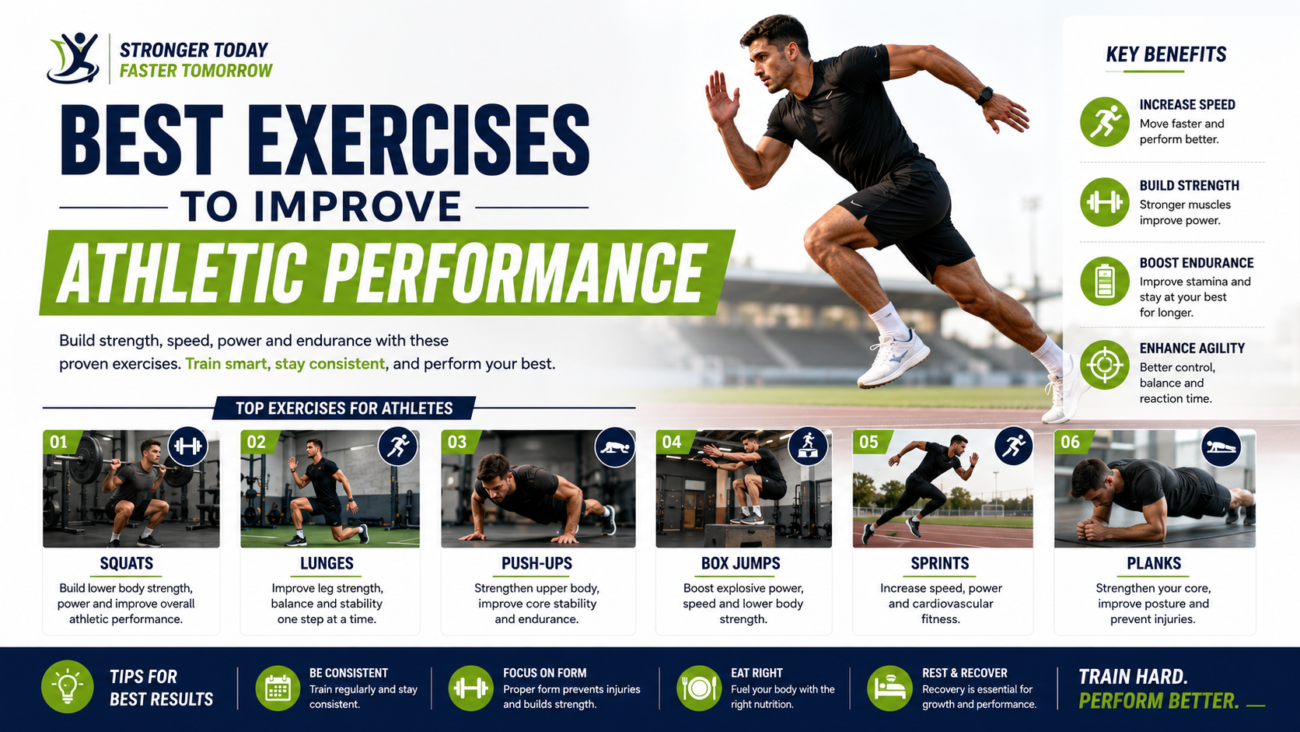
Whether you’re a competitive athlete or someone who enjoys staying active, improving athletic performance takes more than simply working out harder. Strength, speed, endurance, balance, flexibility, and recovery all play an important role.
The good news is that you don’t need a complicated training plan to see progress. Choosing the right exercises and performing them consistently can help you move better, build strength, and reduce your risk of injury.
In this guide, you’ll learn some of the best exercises to improve athletic performance and why they deserve a place in your training routine.
What Is Athletic Performance?
Athletic performance refers to how well your body performs during physical activity.
It includes several key areas:
- Strength
- Speed
- Power
- Endurance
- Agility
- Balance
- Coordination
- Flexibility
Improving these areas can help you perform better in sports and everyday activities.
Why Functional Exercises Matter
Functional exercises train your body to move naturally.
Instead of focusing on just one muscle, they often work several muscle groups at the same time.
Benefits include:
- Better overall strength
- Improved balance
- Greater stability
- Increased coordination
- Reduced injury risk
- Better movement during sports
These exercises build a strong foundation for athletic performance.
1. Squats
Squats are one of the most effective lower-body exercises.
They strengthen:
- Quadriceps
- Hamstrings
- Glutes
- Core
Strong legs improve running, jumping, lifting, and overall stability.
Tips
- Keep your chest up.
- Push your hips back.
- Keep your knees aligned with your feet.
- Lower only as far as you can while maintaining good form.
2. Deadlifts
Deadlifts develop total-body strength.
They target:
- Glutes
- Hamstrings
- Lower back
- Core
- Grip strength
This exercise improves lifting power and posture.
Start with lighter weights until your technique feels comfortable.
3. Lunges
Lunges improve balance, coordination, and single-leg strength.
They also help correct strength differences between your legs.
You can perform:
- Forward lunges
- Reverse lunges
- Walking lunges
- Side lunges
Adding variety helps challenge different muscles.
4. Push-Ups
Push-ups build upper-body strength without requiring equipment.
They work:
- Chest
- Shoulders
- Triceps
- Core
Beginners can start with incline or knee push-ups before progressing to standard push-ups.
5. Pull-Ups
Pull-ups strengthen the upper body and improve grip.
They target:
- Back
- Shoulders
- Arms
If regular pull-ups are too difficult, assisted pull-ups or resistance bands can help you build strength.
6. Planks
A strong core supports nearly every athletic movement.
Planks improve:
- Stability
- Balance
- Posture
- Core endurance
Aim for proper form rather than holding the position for as long as possible.
7. Box Jumps
Box jumps help develop explosive power.
They improve:
- Jumping ability
- Speed
- Coordination
Choose a box height that allows you to land safely and with control.
8. Sprint Intervals
Short sprints improve both speed and cardiovascular fitness.
A simple workout might include:
- Sprint for 20 to 30 seconds.
- Walk for 60 to 90 seconds.
- Repeat several times.
Always warm up thoroughly before sprinting.
9. Jump Rope
Jumping rope is an effective cardio exercise that also improves:
- Footwork
- Coordination
- Agility
- Endurance
It requires very little equipment and can fit into almost any workout.
10. Medicine Ball Slams
Medicine ball slams develop power throughout the body.
They engage:
- Core
- Shoulders
- Back
- Legs
This exercise is useful for sports that require explosive movements.
11. Farmer’s Carry
Farmer’s carries improve functional strength.
Carry a weight in each hand while walking with good posture.
Benefits include:
- Grip strength
- Core stability
- Shoulder endurance
- Overall body control
12. Agility Ladder Drills
Agility ladder exercises improve:
- Foot speed
- Coordination
- Balance
- Reaction time
They’re popular among athletes in sports such as soccer, basketball, football, and tennis.
13. Kettlebell Swings
Kettlebell swings build power through the hips.
They also improve:
- Cardiovascular fitness
- Posterior chain strength
- Core stability
Proper technique is important to avoid unnecessary strain.
14. Burpees
Burpees combine strength and cardio into one movement.
They improve:
- Endurance
- Full-body coordination
- Conditioning
You can adjust the pace based on your fitness level.
15. Mobility Exercises
Good mobility allows your body to move efficiently.
Include exercises that improve flexibility in your:
- Hips
- Ankles
- Shoulders
- Spine
Regular mobility work can improve performance and reduce stiffness.
Don’t Forget Recovery
Training is only part of improving athletic performance.
Recovery helps your body adapt and become stronger.
Important recovery habits include:
- Getting enough sleep
- Staying hydrated
- Eating balanced meals
- Taking rest days
- Stretching after workouts
Recovery supports long-term progress.
Sample Weekly Training Plan
| Day | Focus |
|---|---|
| Monday | Strength training |
| Tuesday | Cardio and mobility |
| Wednesday | Lower-body strength |
| Thursday | Sprint intervals and agility |
| Friday | Upper-body strength |
| Saturday | Active recovery or recreational sport |
| Sunday | Rest and stretching |
This schedule can be adjusted to match your goals and fitness level.
Tips to Improve Athletic Performance
Along with regular exercise, these habits can support better performance:
- Warm up before every workout.
- Focus on proper technique.
- Increase training gradually.
- Eat enough protein and whole foods.
- Stay hydrated.
- Get enough sleep.
- Track your progress.
- Listen to your body when you need rest.
Consistency often produces better results than occasional intense workouts.
Common Training Mistakes
Avoid these habits:
- Skipping warm-ups
- Ignoring recovery
- Using poor exercise form
- Training too hard every day
- Neglecting flexibility
- Not eating enough to support training
- Comparing your progress to others
Improvement takes time and patience.
Frequently Asked Questions
What exercise improves athletic performance the most?
There isn’t a single best exercise. Compound movements like squats, deadlifts, lunges, push-ups, and sprint training together provide a strong foundation for improving athletic performance.
How often should athletes train?
It depends on the sport, experience, and goals. Many athletes train several times a week while including recovery days to allow the body to recover and adapt.
Is strength training important for all athletes?
Yes. Strength training can improve power, balance, stability, and injury resistance across many different sports.
Can beginners perform these exercises?
Most of these exercises can be adapted for beginners. Start with proper technique and lighter resistance before increasing intensity.
Why is recovery important for athletic performance?
Recovery allows muscles to repair, reduces fatigue, and prepares your body for future training sessions. Without enough recovery, performance may decline and injury risk can increase.
Final Thoughts
Improving athletic performance isn’t about finding one perfect exercise. It’s about building a balanced routine that develops strength, speed, endurance, mobility, and recovery. Start with a few foundational exercises, focus on proper form, and increase the challenge gradually as you become stronger. With consistent training, healthy habits, and enough recovery, you’ll build a stronger body that’s ready to perform both in sports and in everyday life.
